Balancing wealth: 3 common pitfalls to avoid
The Jersonal Team • 2024-03-20
Money is not everything, but everything needs money. Most people do not like to talk about money which leads to some persistent misconceptions about the accumulation of wealth. We have collected three common pitfalls and ways to avoid them.
1. Ignoring Conflicts of Interest
Unfortunately there is an inherent conflict in how bank advisors work. The bank advisor can only be paid by provisions. Accepting financial advice without considering potential conflicts of interest is a common mistake even high wealth individuals fail for. On the other hand, simplifying investments into a low-effort portfolio often outperforms options presented by banks driven by their own interests.
Banks rely on provision incomes. Provision is paid for example by actively managed funds if bank customers invest in these actively managed funds which are hard to understand for the investor. Structured products, e.g. an insurance coupled with a savings plan or other combinations of products which are sometimes hard to understand for the customer are even worse, as they rely solely on the sales power of the bank.
The crux however is that these actively managed funds and structures regularly underperform the markets and in addition show a less favorable cost structure than simple ETFs. ETF stands for Exchange Traded Funds which are usually bought via stock exchanges without provision payments or fees in excess of the regular trading fees. ETFs are mostly passively managed funds that replicate stock indices and therefore incur significantly lower cost (starting at 0.03%). This passive investment strategy using indices has been consistently proven to outperform active investment funds over the last decades, see e.g. ➡️📖, ➡️📖, ➡️📖. Furthermore, even past overperformance of actively managed funds is not a valid indicator of future overperformance ➡️📖.
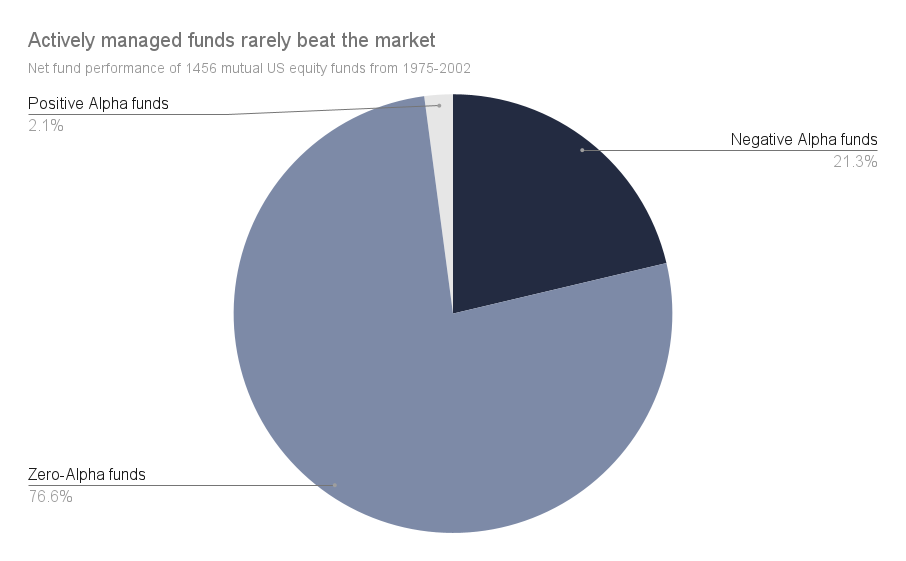
In the years from 1975 to 2002 only 2,1% of actively managed funds have beaten the index, i.e. provided positive Alpha. Source: Luck versus Skill in the Cross-Section of Mutual Fund Returns ➡️📖
Other products that yield bank provisions like investment life insurance policies fare even worse while the coupling of a risk product and the investment product make the products less comparable and more difficult to gauge.
So, how should I invest my money?
Following these five key rules will make your life financially stable:
1. Choose a rule based strategy and stick to it. If you cannot explain the rules, you do not have a strategy and are likely to fail for the behavioral finance flaws that e.g. Richard Thaler described so well in his book ➡️📖. In addition, studies have shown that private investors show subpar performance when they trade frequently, e.g. ➡️📖. Choosing your strategy and sticking to it will not only give you more time for the more important things in life but will also improve your investment success.
2. Start investing early and let exponential growth be your friend. USD 1 invested 50 years ago in US stocks would have accumulated to USD 188 today.Inflation-adjusted the return shrinks to 28 USD, but it is still sizable given the fact that you get paid for not doing anything… Calculate your own period at:: https://www.portfoliovisualizer.com/backtest-asset-class-allocation
3. Volatility of your portfolio is equally important to balance as is return. Focus on geometric returns, not on the average returns that are shown to you!
A common mistake is to view average returns of an asset class. This view does not take into account the losses of the previous term. ➡️📖
This becomes most obvious by discussing the case of total loss: A pilot who does 99% of landing approaches right is? - Correct, dead.
Your return potential of the current period is dependent on how much you have in stock at the beginning of the period.
Not losing too much is more important than gaining more. An easy way to achieve more stability is to split your portfolio into 3 categories and balance them accordingly:
-
Liquidity: You need liquidity that is rapidly available in case something unforeseen happens.
-
Stable Assets: Real estate or bonds provide a stable income. The risk position of real estate is an entire book of its own but for now be careful, if you still have debt on your real estate property. A single 70% leveraged real estate (i.e. the property has still 70% of the value of the property in debt on it) is about as risky as an equity portfolio.
-
Equity: A global equity market portfolio with
4. Avoid active investing unless you have a real advantage over the market or you invest in a market that is not transparent. Passive investment strategies that cover equities around the world regularly beat active approaches as we have referenced earlier already ➡️📖, ➡️📖, ➡️📖.
5. Watch out for investment cost for your wealth accumulation. The reason is the exponential function that makes your portfolio grow. It also makes the cost bite exponentially into your portfolio. You think the effect is negligible? 2% cost of your average active fund (which is not even that much) would decrease the 50 year return on your 1 USD from USD 188 to only USD 68 in nominal dollars.
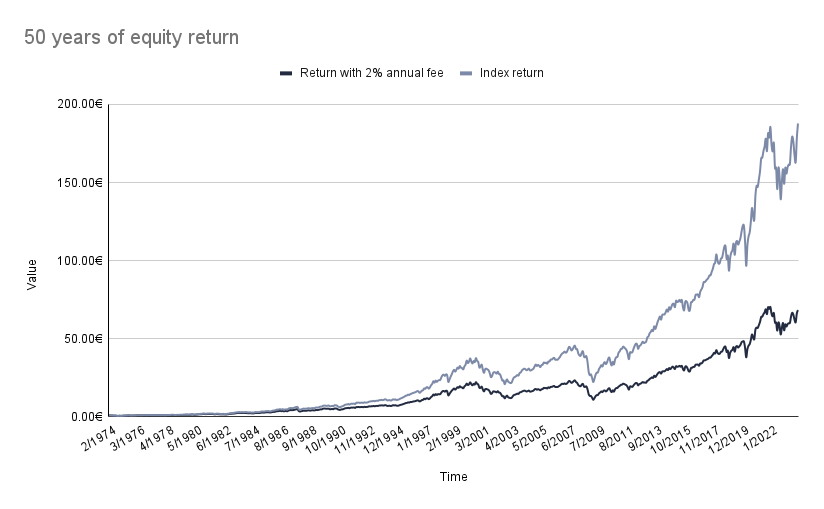
Return of US equities from 1974-2023 with reinvested dividends. Note the impact of 2% annual fees on the return.Source: Portfolio Visualizer
Inflation-adjusted you go from from USD 28 to USD 10. So you should ask yourself how much the coffee at your bank really costs when the next great actively managed fund with 2% fee and 20% high-watermark earnings share is advertised to you… If you feel that you need advice and do not dare to experiment on your own, you can hire a financial consultant who is paid by you directly and has no conflicts of interest. It will cost money but at least you are sure that your consultant is on your payroll rather than someone else's.
2.Underestimating Financial Planning
Delaying the calculation of financial independence and retirement sufficiency is a mistake. Using historical data for simple planning can provide clear insights into financial stability, a step that should be taken early on.
The day will come when you will earn less than the years before. The last possible day that this is going to happen is already known: It is the day of your retirement. Yet, surprisingly few people take the time to calculate their situation early on when there is still time to prepare for this day. Postponing this calculation will make it increasingly harder to achieve the lifestyle that you envision. If you do not want to cut back on your lifestyle, you need to be financially independent by then. But what does that mean?
But is it really enough to be prepared for retirement? What if something happens on the way to retirement? What if for some reason you are not able or willing (!) to work until your retirement date? Knowing what it takes to be financially independent is a powerful asset. It allows you to readjust your life on the go and build a safety net for you and your family. By saving and investing you will get gradually more financially independent. This gives you a chance to redistribute your attention from making more money to the more important or should we say more rewarding things in life like those in the previous or the next section.
So, how do I become financially independent?
You are by definition financially independent when your funds and sssets and the capital gains derived from them will securely cover your expenses until the end of your life. The question is what “securely” means. Your ability to make money from your workforce is limited by the years you can work. A hard turnaround when you realize that your funds are not sufficient at the age of 90 is difficult… This means that we are automatically in a worst case scenario analysis: even in the worst case you do not want to take chances. For most of us the equity and bond markets are going to be the easiest way to save for retirement. Real estate is an option, too, but it is very much dependent on where you live and how diversified your invest is. So let’s have a look at the equity markets.
The financial data from the last century show that there are a few particular bad years to retire. The big crash in 1929 has until now been the worst impact for equity portfolios. Even in September 1929 you could have started retirement if 3.4% of your net worth are all you need for your annual expenses. In other words: Multiply your annual spending (less your fixed income like e.g. pensions, etc.) by 30 and you have your inflation-adjusted capital stock that you need to retire. You can find detailed calculations and models e.g. on EarlyRetirementNow
Differentiate your portfolio by the phases you are in: in a capital accumulation phase more risky and volatile asset classes (e.g. equity markets, leveraged real estate) will deliver higher returns. As you do not need to disinvest you will not suffer too much from the volatility (as long as you stick to your strategy!). When you disinvest to spend money, stability plays a more vital role and a more defensive portfolio will deliver a higher likelihood of lasting as long as you do. You can make your own calculations with a tool like e.g. Portfolio Visualizer.
3. Overprioritizing Wealth:
Yes, you are reading correctly: Wealth is overrated. Too much emphasis on wealth accumulation can overlook the opportunity costs related to family time and personal well-being. Balancing financial goals with quality of life is crucial.
Nobel laureate Daniel Kahneman published a study about the relationship of wealth and happiness (Daniel Kahneman et al. 2010 ➡️📖) stating that an income above USD 75k p. a. does not add to your happiness. Kahnemann’s study has been falsified on the margin, but the core is still true as has been proven in multiple locations and studies around the earth (see e.g. ➡️📖): The marginal increase that the extra dollar of additional wealth adds to your happiness becomes smaller and smaller - the relationship is logarithmic for the vast majority of people as the following graph illustrates:
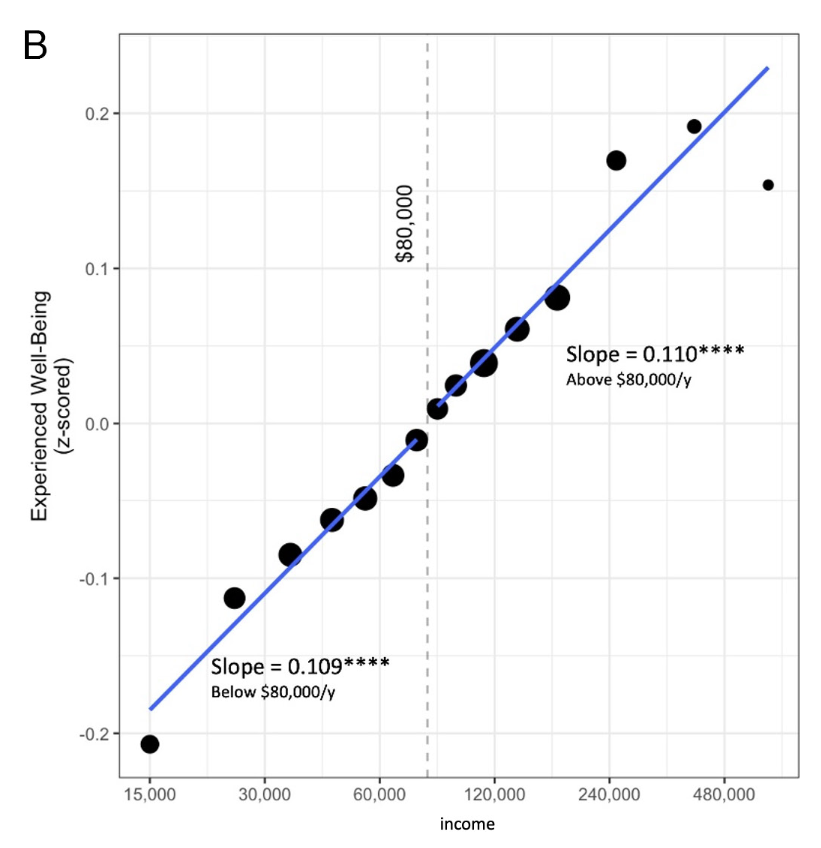
The relationship between wealth and happiness is logarithmic. Source: Income and emotional well-being A conflict resolved ➡️📖
For the least happy people it is even worse: Their happiness flattens out - more money does not mean any happiness gain whatsoever - probably because they have more important things to worry about:
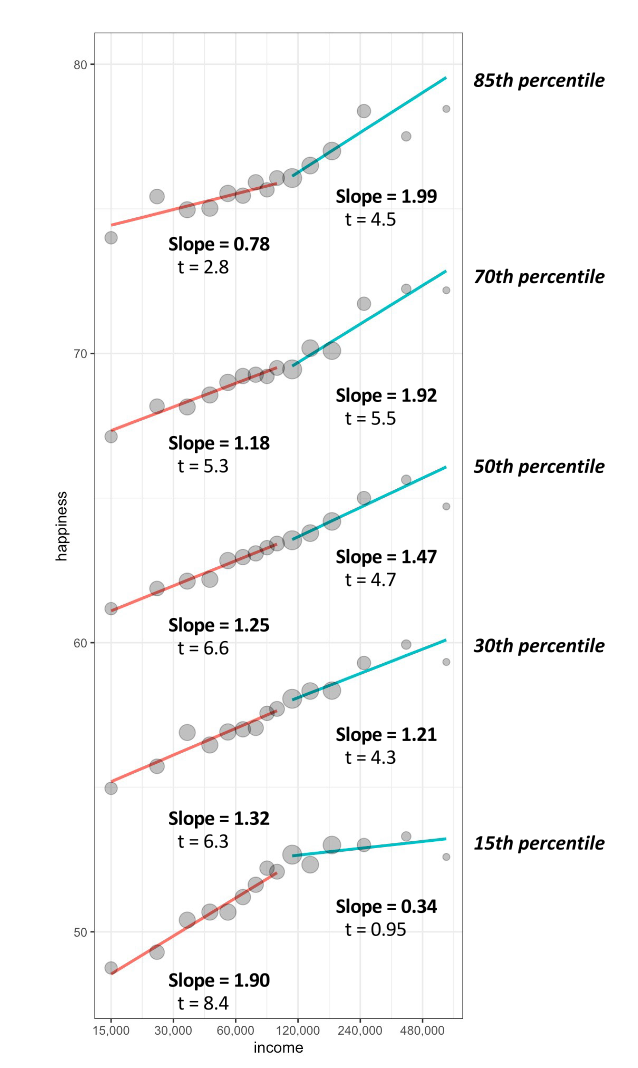
Emotional well-being of the 15th, 30th, 50th, 70th, and 85th percentiles of the person-level happiness distribution. Happy people can get more happy with more money, but the relationship is still logarithmic. For unhappy people more money cannot buy happiness. Source:➡️📖
The logarithmic relationship for the others means that you have to double (!) your income to feel relevant effects. If your earnings are low compared to the median it might be possible to double or even multiple your earnings. In this case the increase in happiness is potentially easier to reach and fairly steep with the additional dollar as was also shown in a representative study in Germany ➡️📖.
To get a grip on how difficult it really is for you to raise your happiness level with money, take your current salary and double it. Now make an educated guess what would need to be true and what you would have to sacrifice to get to this salary level. What would that mean for your health? For your marriage? For your friends? Given the additional effort it takes to double your income, you may find more promising ways to spend your time…
So, how do I prioritize?
The answer to this is not an easy one. Humans are proven to be bad at predicting how certain events may impact their happiness, an ability called “affective forecasting”. The entire endeavor of Jersonal is in a sense our approach to help humans to make better decisions and overcome their biases given the complexity of life. We will dedicate an extra article to affective forecasting but for now it is enough to not that we are mostly able to predict valence (good or bad) of a future event or state and the kind of emotions we will feel. We are considerably worse in predicting the duration of these feelings and the intensity.
Thanks to science we do have an idea of what makes us happy by now (➡️📖, ➡️📖) and it is not by coincidence that this list resembles the structure of Jersonal:
-
Health: Few things impact your happiness as much as pain. Avoiding pain by staying healthy and active is a very good use of your time and effort. See also out article on Health in this series.
-
Warm relationships: The effort to form warm relationships is well invested in terms of happiness. See also the “Relationships” article in this series.
-
Purpose: A purpose in life is a driver for happiness that lasts even when other things are in vain. As David Foster Wallace described so nicely in his famous speech: We will fail if we only strive for the material aspects of life. See also our “Self” article in this series.
What’s next?
We realize this is a lot of material that we just presented. Given your day only has 24 hours you might start to think about reading Seneca’s letters on the treadmill while having a phone conference with your 5 best friends to discuss your retirement plans.
This feeling of being overwhelmed by all the good advice, sorting through it and coming to a set of initiatives that is getting you as an individual closer to your objectives, then measuring the progress and course correct - that is the main purpose of Jersonal.
If you are interested in joining us on this journey click on the link below and join our group of beta testers that will be invited first when the first version of the Jersonal app is launched.