3 key pitfalls to avoid for your health
The Jersonal Team • 2024-03-21
Health is an ultimate cornerstone to a happy and carefree life. We have collected 3 pitfalls to avoid if you want to live a healthy live, which are proven by scientific studies.
1. Stop counting calories and rethink intermittent fasting!
Managing our weight is important for our health as obesity is a key risk factor for cardiovascular diseases. Traditional methods like calorie counting and intermittent fasting often show minimal long-term results. Research supports seeking alternative weight management strategies.
Counting calories has a great impact - for the weight loss industry that generates $58 billion annually in the USA alone. For you counting calories is resulting in a less than 5% chance to have sustained weight loss ➡️📖. If you are estimating calorie consumption you are statistically underestimating your food intake by 47% ➡️📖 - which makes it even less likely to achieve weight loss.
Rather than trying to restrict caloric intake you should focus more on the composition of your food. There is a recent study that suggests that reflecting on the type (not the amount) of food in a food diary could have a substantial impact on body weight ➡️📖. Also small changes in the composition, such as eating more fatty fish, nuts or olive oil can already substantially reduce the risk for metabolic syndrome.
On intermittent fasting the literature shows conflicting results. While few studies have suggested effects beyond the restriction of calories a large meta analysis from 2018 concluded that intermittent fasting has no measurable effect beyond energy restriction ➡️📖.
If you want to fasten - skip dinner rather than breakfast and limit eating to a 6 hour window. There are indications that this early time-restricted feeding has positive effects on glucose levels and biomarkers ➡️📖. From a more practical point of view it is much easier to have control over the content of fiber, protein and the overall macro nutrients of breakfast rather than dinner where in a social setting choice is much more limited.
Skipping dinner comes with the added benefit of foregoing the effect of ingesting more calories when eating in a social setting ➡️📖.
However, fasting in the evening is a major social burden that may not fit in everyone’s routines and social life.
So what should you do in order to lose weight?
Select habits - not one-off interventions: If you can not imagine continuing a practice for the rest of your life it often does not make sense to start it. The body is a well-calibrated system that will move back towards it’s set point after “diet” interventions
No Ultra-processed food: You should try to avoid eating ultra-processed food ➡️📖 - which is everything that’s wrapped in plastic with at least one ingredient you wouldn't normally find in a standard home kitchen. Ultra processed food is a key driver of obesity ➡️📖
Put water into your food: You should try to lower the caloric density of the food you are eating ➡️📖. This could be either by literally adding water and having a chicken soup rather than a chicken steak or by adding lower calorie sides, such as salad. Reducing the energy density is associated with weight loss.
Take food out of the water: While having “watered down food” is a good thing you should avoid drinking beverages that have calories. Avoiding these calories is a relatively easy way to cut down on calories and often sugar.
No sugar that has been separated from its fiber: Sugar is a main driver of obesity and coronary heart disease ➡️📖, ➡️📖. Fiber shows a strong inverse correlation with obesity and heart disease. So try to reduce sugar and in particular avoid sugar that has been separated from its fiber: Eating an apple is fine - having the sugar of the apple juice without the fiber content is not.
Reduce carbohydrates and saturated fats: The above get you already quite far; even when applying these rules we tend to still eat too many carbs and too many saturated fats. Try to avoid too much bread, potatoes and other sources of carbs - especially if they are not full grain. Also switch towards more protein and more monounsaturated fatty acids as they are found in olive oil or nuts.
2. No time for sports in not an excuse for no activity
The human body is designed to move to stay healthy. Lack of time for traditional sports isn't a barrier to staying active. Personalized activity programs can significantly improve wellbeing and life expectancy, surpassing the efficacy of standard apps.
The WHO recommends you to spend 150 minutes with Zone 2 cardio exercises. This means that you can sustain the activity for a long time, are as fast as possible while still being able to have a conversation.
Some people perceive this as an all-or-nothing rule. And even the scientific community was till recently not sure about the minimum dose of physical activity that has a positive effect on longevity. A recent paper has shown that 15 min of physical activity per day implies a 14% reduced risk of dying and 3 year longer life expectancy. Every additional 15 min reduces all-cause mortality by 4% ➡️📖.
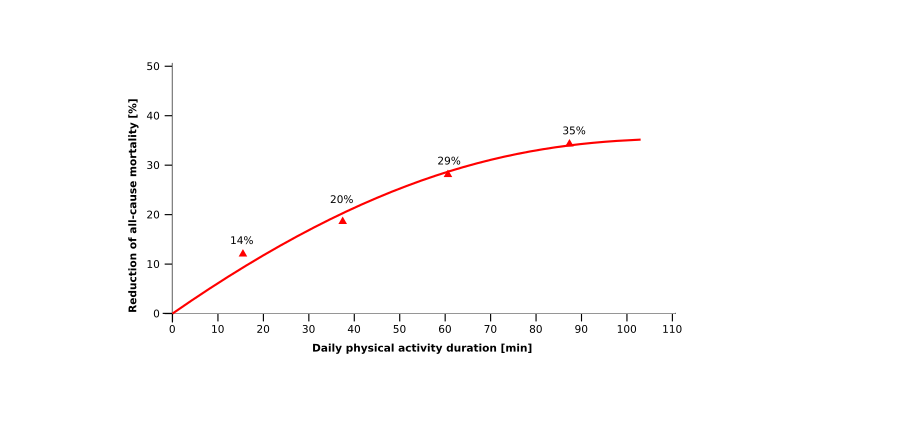
More is not always better as a more structured strength and cardio program can have an even greater effect on your life expectancy.
So what should you do in order to live longer?
If we would have to pick one levers it would be physical activity and exercising. This is the one factor that has the biggest impact on health and lifespan ➡️📖.
In fact this topic is so important that we have a dedicated article on it that explains you, why and how you should best exercise. Here is the TLDR form of this article:
-
Start with 15 min of Zone 2 activity each day
-
Try to extend this to 150 min each week
-
Add 1 hour of strength training each week
-
Add 1 hour of Zone 5 cardio training
-
Add a second and maybe a third hour of strength training
Increasing strength and VO2max are the most potent levers to live longer and stay healthy. Check out this article for more content on it.
3. Do not sacrifice sleep so easily
We often treat sleep as a residual of what is left after we are done with the day or even a sign of weakness in ineffciency. Insufficient sleep, however, affects performance and increases cancer risk. Techniques such as Yoga Nidra and managing light exposure effectively enhance sleep quality.
We are all tough and work hard and the more time we invest in work the better it is going to be. Sleep is overrated - or is it actually important?
Actually not sleeping for one night has the same effect as being legally drunk ➡️📖, which is clearly not a desirable state to conduct important work.
But even those that are able to still perform well while being in a “drunk” state should worry about their health. There is more and more evidence that a lack of sleep in healthy young prospects leads to increased appetite, obesity and increased diabetes risk ➡️📖.
There is a large body of scientific evidence that severe sleep disruptions as shift work are causing cancer. Night shift work -is classified as “probable carcinogen” by the WHO ➡️📖.
In animals jet lag has shown to be carcinogen as well ➡️📖.
Again it should be no surprise that a lack of sleep ultimately makes it more likely that you die. The same is also true for people that sleep much longer than the average ➡️📖.
A very large scale study with more than 85.000 people has shown that it is not only important to have enough light exposure during the day but also to block out light during the night. ➡️📖
So what should you do in order to sleep better?
Next to exercising, good sleep is instrumental for your health. This is a quick checklist to improve your sleep:
- Replace your sleep tracker with a sleep diary. None of the devices at the market is really good at distinguishing REM and non-REM sleep (even though they claim differently). The anxiety they cause can in itself be a reason for bad sleep. A side effect is that you become more self aware of your body.
Note down in the sleep diary when you got into bed, when you were falling asleep, when you woke up, when you got out of bed and a quality rating for your sleep. A sleep diary will also be included in one of the first releases of the Jersonal app.
-
Try to make your sleep as consistent as possible. Example: If you have to get up frequently at 5:30 am, rather get up each day at 5:30h than varying between 5:30 am and 9:00 am.
-
As soon as you are getting out of bed, get as much morning light as possible.
-
Ensure that the bedroom is completely dark and quiet and don't use the bed for anything but sex and sleeping (no work with the laptop in bed). A recent study has shown that it is not only important to have enough light exposure during the day but also to block out light during the night. ➡️📖
-
Especially if you are an early morning person, getting sunlight in the afternoon is quite beneficial.
-
Delay your first caffeine intake for around 90 min after waking up so that your Adenosine can be cleared before the first coffee.
As caffeine remains in the blood for 5-6 hours avoid it in the afternoon.
-
Avoid exercising, difficult discussions and highly interactive content before going to bed. Dark mode on the other hand is most likely overrated. The amount of light from your phone is most likely not sufficient to impact your sleep. It's the content not the light that keeps you awake.
-
Mattress and bedding should conduct heat away from the body as you need a drop in body temperature to fall asleep.
-
If you can't sleep - leave the bed.
-
If you can't fall asleep try Yoga Nidra or one of it's adoptions, such as iRest or NSDR autosuggestion to relax your body.
All these habits are to condition you to sleep when you are in bed (similar to what Pavlov did to his dog). What helps to support that conditioning is up to you. You could support that by using a special ritual. It could be lavender oil, a warm bath or a ritual before going to bed.
What’s next?
We realize this is a lot of material that we just presented. Given your day only has 24 hours you might start to think about reading Seneca’s letters on the treadmill while having a phone conference with your 5 best friends to discuss your retirement plans.
This feeling of being overwhelmed by all the good advice, sorting through it and coming to a set of initiatives that is getting you as an individual closer to your objectives, then measuring the progress and course correct - that is the main purpose of Jersonal.
If you are interested in joining us on this journey click on the link below and join our group of beta testers that will be invited first when the first version of the Jersonal app is launched.