3 life-changing learnings about relationships
The Jersonal Team • 2024-03-19
Good relationships have a positive impact on several key aspects of life. We have collected 3 key aspects to know about social relationships that might change your life and the way you look at it.
1. Marriage Boosts Longevity
Solid marriages can increase lifespan, even more than exercise.
A systematic review of life expectancy among 164,597 men and women in the US ➡️📖 showed that married men and women lived 2 years longer on average than their unmarried counterparts (while the never married lived shortest!). Note: The study did not differentiate whether the marriage was happy or not but relied solely on the legal status.
Other studies with a more sophisticated measure of relationship status and level of loneliness showed an even more pronounced effect of up to 7 years for women and 12 years additional life expectancy for men. A meta study ➡️📖 puts the effect on lifetime in the range of risk factors such as physical activity, obesity or substance abuse.
So, what does that mean for the average relationship?
We will certainly not give general advice on how to lead a relationship. The dynamics of couples, let alone families are way too complex to cover them by basic scientific studies let alone double blind trials. There are however a few things that science has found out that might be worthwhile to know.
1. Hollywood does not need to last forever: It is absolutely normal that the excitement within a marriage or a long term relationship is fading with time. A longitudinal study with 85.000 participants in Germany that is running in a representative sample since 1984 (and still is!) showed that marriage or a comparable long term-relationships are the most influential source of happiness ➡️📖. However, this happiness becomes weaker with time. After 15 years people who are married are just as happy on average as their unmarried counterparts.
2. It is worthwhile to work on your relationship: Except for toxic relationships the potential “step into independence” remains a myth ➡️📖. People who get a divorce experience steep unhappiness during the divorce and do not profit from a long-term increase in happiness - even if they remarry someone else.
3. Warning signs for your relationship: A study by John Gottman found that two factors were 93% accurate in predicting divorce:
Early divorce (i.e. during the first years of a marriage) was predicted well by strong negative affect during conflicts even though positive affect of the couples that divorced was just as strong as for the couples that did not divorce
Later divorce was well correlated with a lack of positive affect between the partners, e.g. showing low interest in what the other partner had said or achieved
2. Warm Relationships Predict Success
Forming positive relationships is crucial for happiness, longevity and financial success.
An 80 Year long longitudinal study identified the ability to form and maintain good relationships to other people as the main factor determining happiness in life ➡️📖. The study found that those people who formed good and warm relationships were happier than their more affluent and more successful peers. Other studies have shown similar results ➡️📖.
In addition there was a positive relationship between relationships and longevity. Social isolation increased mortality risk by 30% (comparable to the effect of smoking) as researchers found in a review study ➡️📖.

Loneliness and social isolation have a proven impact on physical diseases. Source: Loneliness and Social Isolation as Risk Factors for Mortality A Meta-Analytic Review ➡️📖
The Grant Study, a large longitudinal study conducted over 8 decades by Harvard university, showed that even financial success is depending more on warmth of relationships, than on intelligence.
-
Those who scored highest on measurements of "warm relationships" earned an average of $141,000 a year more at their peak salaries (usually between ages 55 and 60).
-
No significant difference in maximum income earned by men with IQs in the 110–115 range and men with IQs higher than 150.
The study revealed also surprising results on relationships within the family: The warmth of childhood relationship with mothers matters long into adulthood:
-
Men who had "warm" childhood relationships with their mothers earned an average of $87,000 more a year than men whose mothers were uncaring.
-
Men who had poor childhood relationships with their mothers were much more likely to develop dementia when old.
-
Late in their professional lives, the men's boyhood relationships with their mothers—but not with their fathers—were associated with effectiveness at work.
-
The warmth of childhood relationships with mothers had no significant bearing on "life satisfaction" at 75.
The warmth of childhood relationship with fathers correlated with:
-
Lower rates of adult anxiety.
-
Greater enjoyment of vacations.
-
Increased "life satisfaction" at age 75.
So, how does relationship building work?
Again, this article can never even try to cover the subtleties of forming a good relationship with others. But there are a few biases that seem to harm our ability to bond in the first place. People systematically underestimate the importance and impact of relationship building in their life even in the most casual settings. Researchers from the University of Chicago ➡️📖 instructed commuters on trains and buses to connect with a stranger near them, to remain disconnected, or to commute as normal. In both contexts, participants reported a more positive (and no less productive) experience when they connected than when they did not. Separate participants in each context, however, expected precisely the opposite outcome, predicting a more positive experience in solitude. The study found that participants seemed to underestimate the interest of the other people to engage in communication.
The good news is that the same study showed that it does not matter whether you are genuinely interested in the other people or just being told (e.g. by this blog) to start communication: When they did a study in a laboratory waiting room, participants who were talked to had equally positive experiences as those instructed to talk.
What is true about casual conversations in a train or waiting room for a short period of time is especially true for the long run: A very direct way to increase happiness in life is making close friends ➡️📖. The number of close friends is limited as it takes effort and capacity to maintain close relationships. Analysis of 6 billion phone calls has proven this early hypothesis by social scientists ➡️📖. Up to 5 friend’s however each new close friend has resulted in a significantly higher happiness level in life which was comparable to the effect that an additional child would have! The effect fades beyond 5 close friends as the marginal gain is not that significant any more.
It seems that those who underestimate the positive consequences of social interactions may not be social enough for their own well-being.
3. Benefits of Volunteering
Volunteering not only helps others but also enhances personal happiness and longevity.
Volunteering for a good cause is something that you need to be able to afford: It takes time and effort - and sometimes even money to volunteer. Recent study results rather raise the question whether one can afford to NOT volunteer. Volunteering has been proven to reduce mortality risk by 24% (adjusted for the health status of the individuals) for adults above the age of 55 in a meta analysis ➡️📖.
Volunteers experience a greater happiness than their non-volunteering counterparts the more often they engage and the older they get ➡️📖. This is even more pronounced if you take into account the additional “side-effects” of finding friends and building social connections while volunteering. The foloowing graph show the effect:
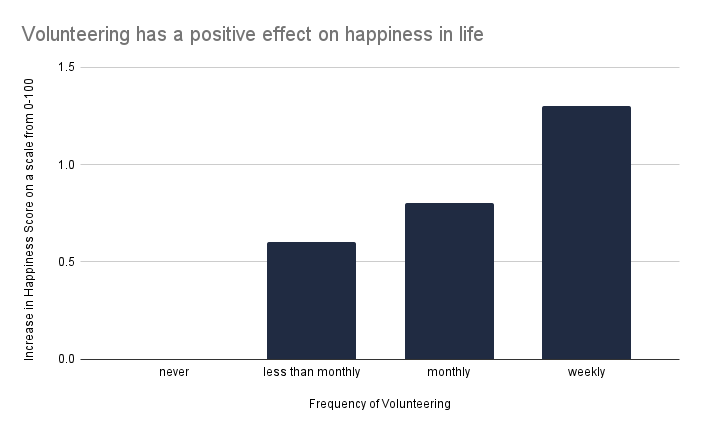
The more you volunteer the more your happiness increases. Source: Martin Schröder: Wann sind wir wirklich zufrieden? ➡️📖
But wait, only a score of 1.3 on a scale of 0-100 in happiness? Is it really worthwhile? Well, we should mention that this is the same magnitude of increase in happiness that people experience when they receive a donation of 200-500kEUR! And who would not want to receive so much money? In addition, the effect is about twice as big as the average if you are older than 50 years. The explanation for that may be that volunteering provides people with social contacts they would not have without. This becomes increasingly important as people grow older and have more limited opportunities to get to know other people.
What’s next?
We realize this is a lot of material that we just presented. Given your day only has 24 hours you might start to think about reading Seneca’s letters on the treadmill while having a phone conference with your 5 best friends to discuss your retirement plans.
This feeling of being overwhelmed by all the good advice, sorting through it and coming to a set of initiatives that is getting you as an individual closer to your objectives, then measuring the progress and course correct - that is the main purpose of Jersonal.
If you are interested in joining us on this journey click on the link below and join our group of beta testers that will be invited first when the first version of the Jersonal app is launched.