3 ways to improve self care
The Jersonal Team • 2024-03-18
Here are 3 ideas on how to start working on becoming a better version of yourself. Only with the right pupose in life and a toolkit to manage change you are able to address all the other challenges in life.
Working on becoming a better version of yourself is the starting point for being successful in the financial, social and health space. Mental health challenges, stress, or a lack of goals in life or not having the tools to pursue these goals can render all initiatives meaningless.
There are quite a few science-backed initiatives you can take on today in order to improve your mental health, and become more effective in changing towards your goals.
1. Having a purpose in life - the holy grail of health and wellbeing
***Having a purpose in life is next to regular physical activity and magic fairy dust, the most important thing you can do to improve your health, lifespan and wellbeing. ***
Having a sense of purpose is improving your health ➡️📖, makes you wealthier ➡️📖, improves relationships, sleep ➡️📖, makes you less likely to get Alzheimer’s Disease ➡️📖 and increases the lifespan ➡️📖 as shown in the following graph. The higher the result of a psychological questionnaire assessing the meaning of life, the higher the probability of survival:
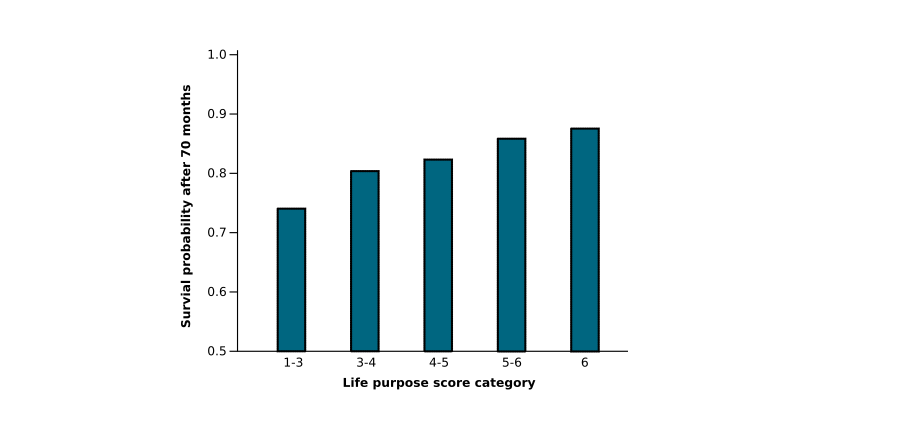
Source: Association Between Life Purpose and Mortality Among US Adults Older Than 50 Years ➡️📖
If you search online for “PIL - purpose in life test” you will find a structured questionnaire that provides you with an assessment of your baseline to start from. Here would be one implementation but there are many different ones online to choose from.
There is not one silver bullet solution to find your purpose. We really like Carl Jung’s approach to question what you would be willing to sacrifice yourself for in order to get closer to something that is more valuable to you than your own existence.
At some point in the future the purpose of your life is the only thing that is there to stay after your own death. So it is no surprise that it is a big motivator. However even after you have set yourself a goal and a purpose to aim for there are many things that can get into your way: The lack of focus, mental stress and the lack of time to work on the things that are important to you in the long term.
2. Fighting stress and distraction
A moderate amount of stress can actually be a good thing. Without being stressed our muscles would not grow during exercises and as long as something is demanding but enjoyable, stress can be a good thing. On the other hand, stress can cost us many year of our lifespan.
It is however no surprise that too much stress is not good for our mental health. A review of work-related stress in the banking sector ➡️📖 showed that stress has a clear negative impact on mental health, such as depression or psychiatric disorders.
And stress does not only affect mental but also physical health. Stress is creating a positive feedback loop with Obesity ➡️📖, ➡️📖 and thereby increases the risk of metabolic syndrome and ultimately also increases the mortality risk.
Don’t be distracted
Besides stress, distraction is the other important hindrance to achieve your goals. A classic study ➡️📖 analyzed people’s thoughts, activities and level of happiness throughout the day by capturing the participant's thoughts, actions and feelings in real-time on an iPhone. The nature of people’s activities had only a modest impact on whether their mind was wandering or not. Whenever their mind was wandering people were less happy - to the point that a wandering mind can explain around 11% of the in-person variance in happiness while the activity performed can only explain 5% of the variance.
Another more recent study ➡️📖 from 2019 showed that the duration of irrelevant distractions by both mobile phones and mindwandering was significantly associated with reduced reported levels of happiness.
Meditation to the rescue?
If you sit in a train or an airplane and don’t have a book, practicing meditation can be a great way to improve your focus and concentration or to work on being more relaxed. There is a great science-backed meditation practice that will improve attention, memory and mood ➡️📖.
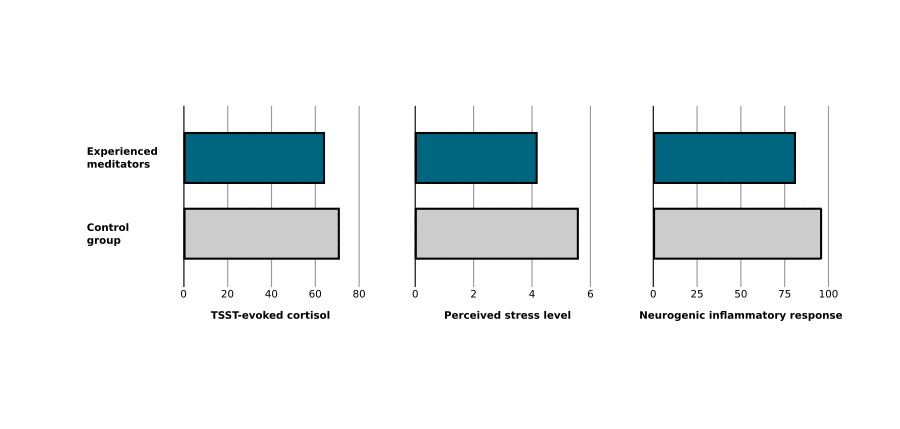
Research even shows that experienced meditators have lower cortisol levels after upsetting experiences and lower inflammatory response ➡️📖
Other forms of meditation can improve problem solving skills and focus ➡️📖.
In another article we mentioned Yoga Nidra, a meditation practice that is used to improve sleep. Meditation can also be a great way to lower stress ➡️📖.
It is however important, to choose the right form of meditation. Scientists tend to distinguish kindness-oriented, focused attention and open monitoring types of meditation. Some forms of mindfulness meditation are inducing wakefulness ➡️📖 and decrease the sleep need ➡️📖.
So don’t just meditate under the assumption that it will be an all-purpose solution. Set an objective and then analyze what measure works best for you. The answer might be meditation but it could also be a breath exercise that is more effective for that case ➡️📖.
3. Work towards what you want to be - not what you want to have
***If I am who I am and not what I have, no one can deprive me or threaten my security and sense of identity. (Erich Fromm) ***
Erich Fromm wrote in To Have or To Be ➡️📖 that there are two types of goals - things you want to have and what you want to be. Long-term compliance with goals you want to have (like having a six-pack, having 1 million EUR) tends to be low as once you lose weight, you get visible abs, there is longer a reason for sticking to your habits.
Therefore work on your identity (I am a healthy person, I am a great father) and your purpose (I am going to be a healthy grandfather for my grandchildren) and then establish habits that you feel comfortable to keep for the rest of your life. Changes that are linked to your identity are much more likely to succeed ➡️📖, ➡️📖.
As James Clear describes in Atomic Habits ➡️📖 the initial habit should be so small that you can integrate it without any friction into your daily routine. Rather than aiming for 3 hours in the gym when you have time, start to aim for 5 push ups every morning.
We hope you found something helpful in this overview. We are currently working on a more structured way to diagnose and work on yourself. If you want to stay in touch for future articles or become part of the test user group please subscribe to our newsletter.