How science-based exercise training extends your lifespan
The Jersonal Team • 2024-02-21
In this article we are going to discuss scientific reasons why you want to exercise, what type of exercise is best suited for improving your health and how to select the best exercises for you.
Reasons to exercise
In the middle age selling of indulgences was very popular. You got a small piece of paper with an official stamp and you longer had to worry about purgatory, judgment day and other nasty things to come. People bought the indulgence letters based on the vague belief that these will result in a better future.
While these times are over the mindset of many people when it comes to sport and exercising is not that different from indulgence trade. Someone in their distant past - maybe parents, teachers or a fitness influencer told them to exercise and now they run some kind of exercise regime. While this is better than doing nothing (we will come to the reasons later) any activity that is only based on believes and not connected to any control of the outcomes tends to be ineffective. If you find yourself in this group please continue reading the article and you might start to work out much more effectively.
Another reason to exercise is to look good. Man want to get rid of belly fat and love handles and women want to get ready for bikini season. Using visual signals as part of the mating behavior is a common reason - not only among humans but also animals often use their look to impress potential partners. This might be something to look at in a future article.
Today we want to talk about exercising to be healthier and live longer. As we will see the right type of exercise has the potential to increase human lifespan and health span quite dramatically. So you will not only live longer but also spend much more time healthy and fit.
What type of exercise increases lifespan?
The core principle of exercising is quite simple. When you use a part of your body extensively and the body feels that is is a stretch to do the exercise your physiology will adopt to better support this type of action.
In order to live longer there are three clusters to optimize for
Cardiovascular: As any other muscle in your body you can train your heart and your lungs for better performance.
Strength: All your remaining muscles can be trained to become stronger - where we have strength training
Mobility and core stability: You want your core to be stable and you joints to be flexible to allow for maximum flexibility
Not all of these are equally important - which we will discuss towards the end of the article. Let's take a look at each of the three areas.
Scientific methods for cardiovascular training
Let's start with a look at your heart and lungs. It's their job to get oxygen to your muscles and to your brain. How much oxygen your body is able to transport and consume is measured by the maximum oxygen consumption VO2max.

Among all the measures that predict longevity VO2max is one of the factors that shows the strongest impact on decreasing mortality. A study with more than 100.000 people showed that if your are in the top 2% of your VO2max range you are 5 times less likely to die compared to the lower end of the spectrum. In comparison the impact of smoking is only a factor of 1.4. ➡️📖
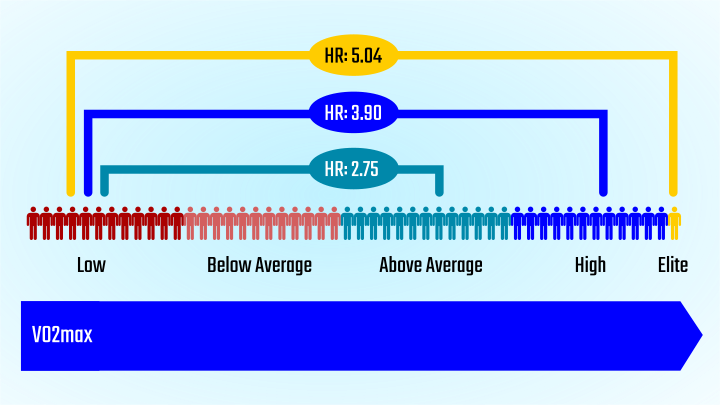
For us moving the needle this far in terms of health benefits is really worth working on VO2max.
VO2max diagnostic
You might be curious where you stand regarding your VO2max. There are different methods how to measure or estimate VO2max:
-
Measurement on a training device while measuring oxygen
-
Approximation by a smart device
-
Approximation using the Rockport fitness walking test
-
Approximation using your heart rate
If you are in a gym and they offer a VO2max test you should take it. This is the only way to really measure VO2max. Usually you are on a treadmill or bike, wearing a mask and exercise for a while.
Your smartwatch may give you a calculated value as well; this is however usually only a more or less accurate approximation. Most smart watches do not share how they calculate the VO2max but they will use an estimation similar to the one we describe below.
A good approximation of VO2max is the Rockport fitness walking test. You walk a mile or 1.6 km as fast as you can without jogging or running and stop the time. Then you measure your heart rate directly after the walk. You can then put the values in the calculator below to calculate your VO2max:
If you are reading this on the sofa and don't want to get up but have some kind of heart rate monitor on your smart watch or another device you can roughly approximate your VO2max by looking for the highest heart rate you ever had and divide it by the heart rate you have when fully rested. Multiply this value by 15.3 and you get and approximation of VO2max.
If the highest heart rate observes is 165 and your resting heart rate is 66 then your VO2max would be 38.
VO2max evaluation
Now you have a value and might ask yourself weather this is good or bad. You can take a look at this curve to figure out where you are in comparison to your age group (based on this table):
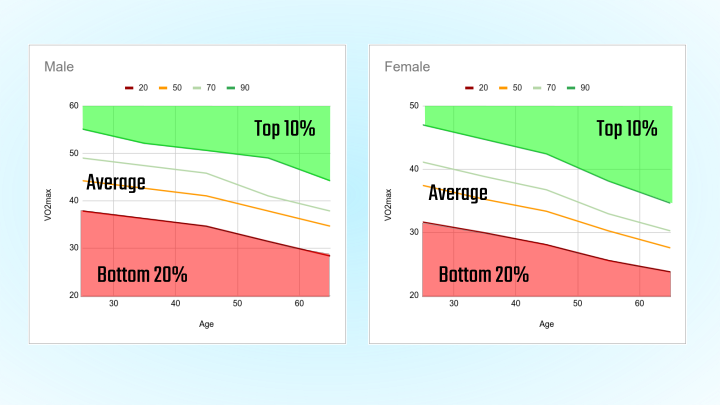
If you are male and 35 years old the VO2max of 38 that we just calculated would be below average. For a 60 year old person the same value would be around average.
If you are in the top 5-10% of your age group - congratulations. You should continue your training regime. For all the others let's break down what you can do for cardiovascular training.
Improving VO2max
To improve your VO2max you can perform two different types of activities
Aerobic Zone 2 activities are activities such as cycling, hiking, swimming or playing tennis performed at a level that feels like work but you could still have a conversation and could do the activity forever
Anaerobic Zone 5 activities are the most demanding level of a certain activity. You would still be running, swimming or cycling but at a level that you can only sustain for a few minutes and that lead to a situation where your muscles consume more oxygen than the body can deliver.
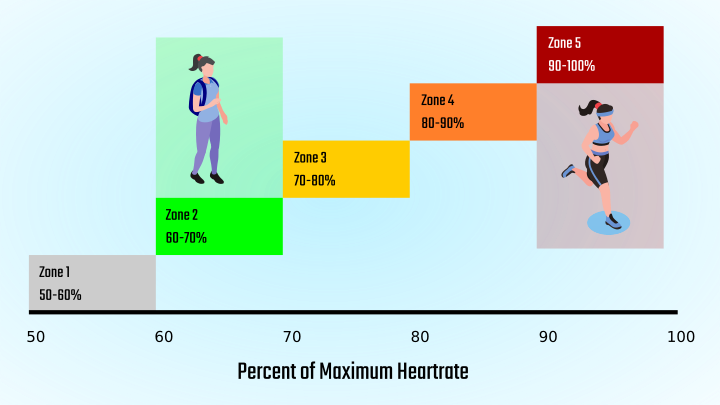
Ideally you should get 2,5 hours of Zone 2 aerobic training each week. This seems to be a lot but you can aim for 30 min at 5 days a week and you can integrate Zone 2 work into your daily routine. ➡️📖, ➡️📖, ➡️📖
For some time there was the believe that only a certain amount of activity would yield you with benefits. Recent studies show however that already 15 min of Zone 2 per day could increase your lifespan.
While the Zone 2 training is improving your metabolic functions, trains your heart muscle and improves VO2max training in Zone 5 pushes your mitochondrial function and VO2max even further. ➡️📖
Training in Zone 5 most of the time follows a High-intensity interval training protocol where you switch between short periods of Zone 2 and Zone 5 activity. Typically one would use a 4x4 pattern where 4 minutes of low intensity are followed by 4 minutes of giving everything you can.
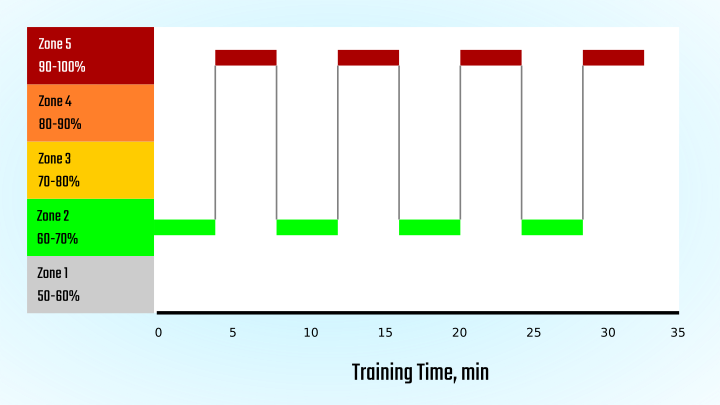
You should aim for 1 or 2 of these High intensity interval sessions each week. We know time starts to add up - we will later get back to the question what to do when you only have limited time for exercising.
The science behind strength training
Now let's move from cardio to strength training. When looking at types of strength training we see three types:
-
Ineffective training with no effect
-
Training to have more muscle mass
-
Training to have more muscle strength
The ineffective training is most of the time a result of someone believing in the "sport is good" indulgence letter. A lot of the modern fitness apps will also claim to improve strength. They will for example ask you to do 10 push-ups. The push-ups are demanding and you expect to become stronger that way. This is unfortunately not true.
As we stated already in the beginning, muscles only change if they are required to work close to their limit. Anything below this limit might result in Zone 2 cardio training but not in a strength increase.
Lets assume that 50 kg is the maximum you can somehow lift. The 50 kilogram is called 1 Rep max - the absolute maximum you can move once.
If you move 50 kilogram once your muscle gets the signal to grow in size and strength. You can have the same effect with lifting 45 kilogram 4 times or 40 kilogram eight times. If you however only move 25 kilogram even 10 or 15 times your muscle will not grow.
If you want to learn more about the optimal range of repitions you want to search for Prilepin's chart - which nicely explains where you work on which characteristic.
Without a diagnostic of 1 Rep max and then pushing you towards that limit exercises tend to have little effect on strength.
If you train your muscles correctly you can train either for getting more muscle mass - what's called hypertrophy - or for muscle strength. While most people would associate muscle mass with muscle strength these are two separate characteristics that have to be trained differently.
When you want to optimize your health and lifespan it is more important to build strength rather than muscle mass. A study of more than 4.000 participants showed that while strength is decreasing the mortality risk, muscle mass does not have the same positive effect. ➡️📖
How to train muscle strength?
To train strength you want to be able to repeat the exercise 1 to 5 times, then rest and run 3 to 5 of these sets. For muscle growth you rather aim for 8 to 12 repetitions with a lower weight. ➡️📖
When you are training in a gym you should get coaching how to increase your load so that you stay in the optimal range for building up strength while still performing the exercises in a controlled and safe manner. Smart machines and apps might help you stay on target and gradually build your strength.
Building up strength at home is a bit more difficult. Instead of changing the weights you have to change the type of exercise - what's called a progression. When you are able to do 10 push-ups you should elevate your feet and when can do 10 push-ups with elevated feet you should move step wise towards push ups on one arm.
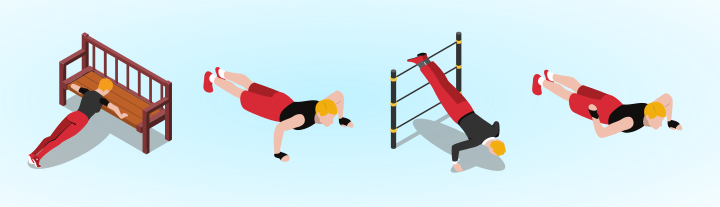
If you want to train with your body weight we would recommend the Recommended Routine that has been developed by a large group of people. The recommended routine is a combination of Pull-ups, Squats, Dips, Hinges, Rows, Push ups and core exercises. This training approach uses progressions so that you always stay in the range of strength increases and addresses all the muscle groups of your body.
The Recommended Routine is certainly not ideal but a good starting point. We are experimenting with an AI-based exercise program. Subscribe to our newsletter if you want to stay informed about our progress there.
Strength training should be done at least 1-2 times a week and ideally 3-4 times each week.
Core stability and flexibility
For core stability we have on the one hand side preventive training. Your strength training program should contain some exercises that improve the stability of your core - as it does for all the other muscle groups. If you are looking for additional exercises we will link to a paper with additional ideas these papers offer additional ideas around core stability training: ➡️📖, ➡️📖
On the other hand core exercises can be necessary to address back pain or back problems. In this case you should work on the program with your physiotherapist as it will require a program that is tailored to your specific pain and situation.
Our recommendation would be to incorporate core strength as part of the overall strength training and only do dedicated training sessions, such as Yoga or Functional training if your have back pain or other challenges. ➡️📖
Stretching increases the range of motion and flexibility of your body. The scientific literature is however inconclusive if stretching really helps to prevent injuries and to our knowledge there no evidence for a direct effect of stretching on your lifespan. ➡️📖, ➡️📖
We would therefore recommend to do opportunistic stretching to support your other activities. ➡️📖. If you are running your want to work on the mobility of your leg muscles and as a tennis player you want to work on your arms. To get you started on incorporating some stretching exercises in your workout plan we would recommend this Navy Seals Guide.
If your goal is to increase the range of motion, static stretching or Yoga seems to be the most effective approach. ➡️📖, ➡️📖
For an effective increase of the range of motion you should work around 5 min on each muscle group - ideally over 5 sessions each week ➡️📖. This is another example where doing a little bit here and there is not going to cut it.
You should not do stretching before the strength training as there are multiple studies that show that stretching before the training limits your performance ➡️📖. You could do stretching after the strength training. While the "cooldown" training is proven to have no measurable effect is also does not hurt to do stretching after the strength training. In any case you should to a regular and frequent schedule in order to see an effect on your mobility.
How to prioritize exercises when you don't have time?
Even when leaving out dedicated core stability and stretching training we have a quite impressive schedule of around one hour every day. So what should you do if you don't have that much time for exercises?
If you don't have any time for exercises try to get some physical activity for 15 minutes each day. This will increase your lifespan by around 4 years. This could be the 7 minute workout and jogging on your way to the train or when getting back from work ➡️📖.
If running, cycling or swimming is not your favorite yet and you just don’t know how to fit this into your weekly schedule, you might want to try one of these ideas to get your workout doing just daily things:
-
Leave the train one station earlier and walk the remaining distance to work
-
Go by bike when you normally would use a car
-
Take a walk while being on the phone
-
Go for a hike with your family
The more Zone 2 you can get into your schedule the better - you have a direct positive effect up till 180 minutes per week ➡️📖.
If you get some Zone 2 work done and only have 1 hour each week we recommend you to do strength training following the Recommended Routine so that you don't have to invest time going to the gym.
A study on more than 400,000 US adults showed that strength training 1-2 times a week has already a significant effect on mortality risks ➡️📖.
With a second hour available each week you should include a High-intensity interval training to improve on VO2max.
The hours number 3 and 4 should go towards additional strength training sessions.
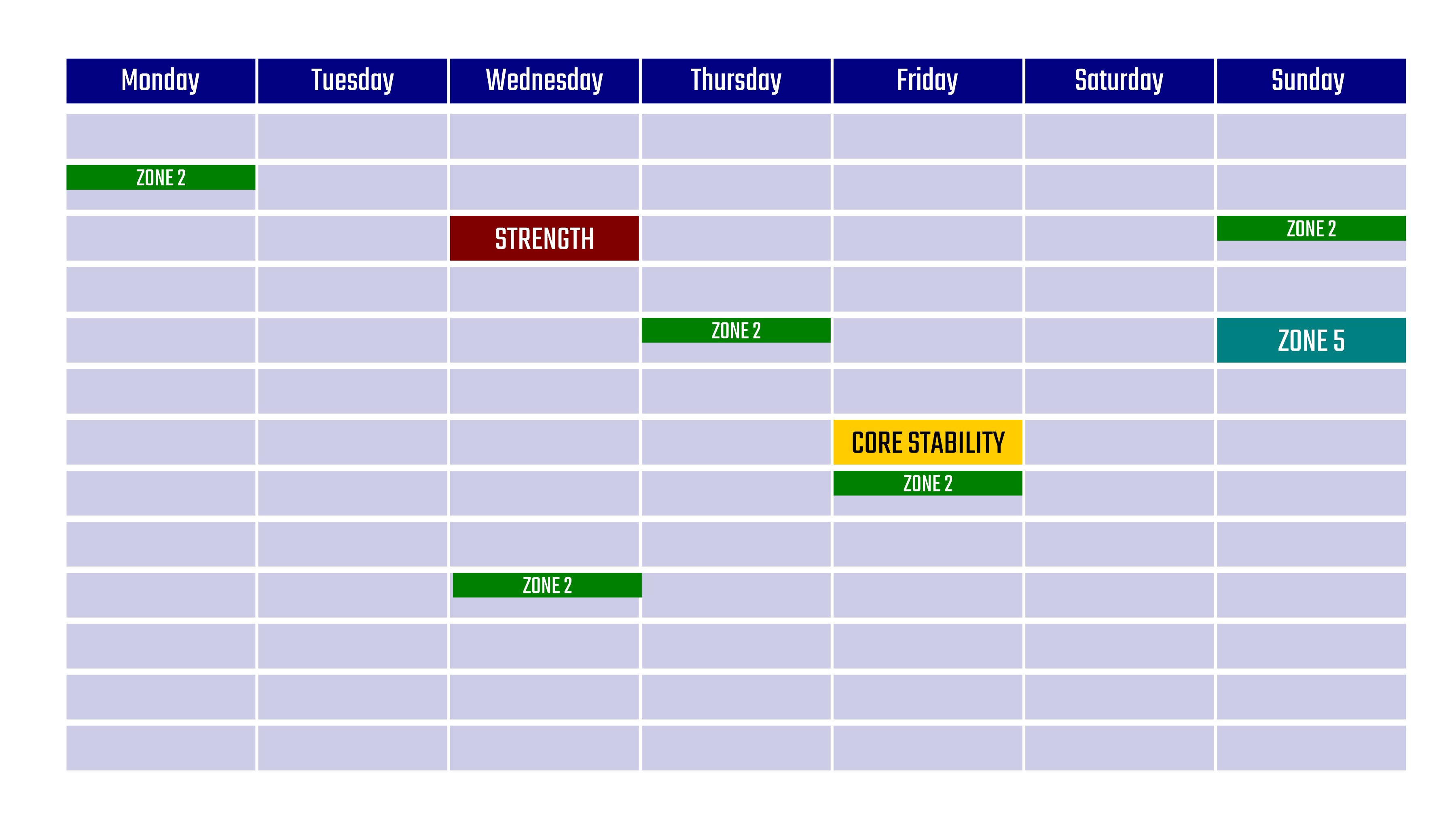
You see that depending on how much time you have there is a lot you can do for your health. Take this schedule as a starting point and adjust it to your needs.
Don't forget to subscribe to our newsletter to stay up to date on how science can improve your life, your health and your happiness.